We’re deep in the summer, which means it’s about time for me to contend with Unexpected Expenses™. Just about every year I venture into the off season with some vague notions of what might be done in or around the house if all goes well. It’s a fun game I like to pay, as the wheels usually fall off the wagon pretty quickly.
This year I had vague notions of hiring a contractor or handyman to do a little work on the back deck, and I think it’s high time we updated our living room furniture. What I’ve ended up doing instead, however, is first attempting to get our lawn care folks to remove some ivy (they would not, for there is some poison ivy in there, and half the crew is desperately allergic), then hiring a student (strongly resistant to poison ivy per his mother) to tackle the job for us, and then noticing some raccoon scat in the backyard while outside to hand off a bottle of Gatorade. The especially bad news for us is that our wildlife control guy retired and handed off his business to another company, and they do not have a person licensed to remove critters in our area. They did have a referral to offer, however, so I gave him a holler, and we’re in the process of trying to send our raccoon friend away.
This critter, however, has been raccooning for awhile, and we might need a bigger trap. Just look at this guy:
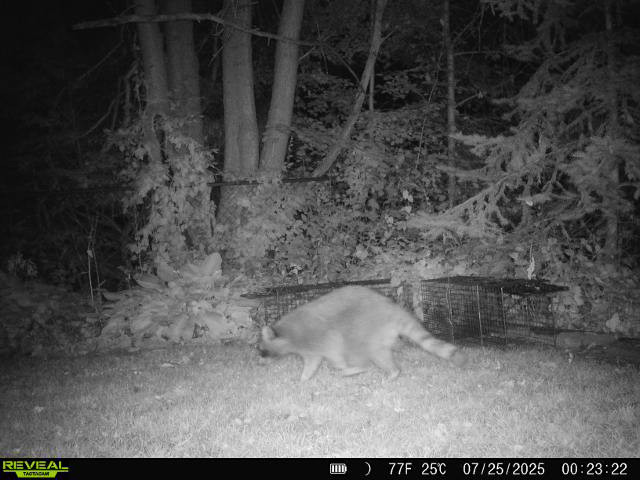
The new wildlife control folks differ philosophically from the older guy. He was pretty surgical in his planning, laying out bait raccoons (and only raccoons–he trapped nothing else) love in their travel lanes and landing them one at a time. The new guy set seven traps out and has a per-critter rate, which is typical of the big companies in the area. So far we’ve caught one raccoon, two opossums, and a groundhog; the big feller still roams free. So the cost keeps ticking up, though we know the guy we’re after is on the loose.
The tricksy bit here is that it’s not too tricksy. I can afford the new guy’s rates with little discomfort, and I’ve got enough salted away to cover a bunch of other Unexpected Expenses™ if necessary. But I worry, and I’m very skilled at worrying.
One of the perils of being me is that I grew up with precarity, that state of perpetual economic uncertainty plenty of folks know. My father died when I was twelve, and he left a bunch of medical expenses behind. And thanks to some bureaucratic legerdemain, some benefits that were paid out upon his death were later chased down by bureaucrats, who are, as most folks know, always evildoers. (As a writing #protip, the easiest way to identify evildoers is to kill them in fiction; in virtually all cases the bureaucrat is a free space on the bingo card–you can toss them in a wood chipper and readers won’t care. That’s a persistent pattern even in a world in which folks can be a little skittish about offending anyone.) My mom was a Hero of Home Economics, who managed to feed herself and two oversized teenage boys on one income. But back in the day there was a discernible pattern: she got paid on Thursdays and did the grocery shopping on Thursday nights, which meant the cupboards were fairly bare on Tuesdays. One of my mom’s few faults was the Storm-Off™, which she rarely resorted to but which amplified my sense of how dicey life can be. She usually just needed an hour on the road to clear her head, but of course when you’re not all that worldly (and I’ve never been an especially worldly entity) it feels a lot like being utterly abandoned for cause. And if you’re properly maladjusted, you learn to shoulder your share for those episodes. If my mom had driven off and ditched us, I think most folks would have been pretty sympathetic.
So what happens? In response to precarity, you first get The Worry, then you get the Reaction Formation. “All is well!” insists the Bald Man–and in truth, it is–but he does not feel at all that all is well. The trick, he tends to believe, is that it shouldn’t show. He becomes a little thriftier, but in a decidedly low-key way; he will not skimp on any of the household necessaries, nor will he kvetch when the power bill triples, but he will not splurge on stuff he might like for his own amusement–just in case.
The catch that comes with the precarity pattern is that I know it, and know it very well. I know how little is affected by my day-to-day expenses, and how quickly I can recover from modest missteps or unexpected expenses. Even so, my wiring from past experience tells me that a little panic might be worthwhile, so my stress mechanisms kick into high gear.
The diagnosis of my vasovagal syncope has made me a little more mindful about stress management, but this is one of those sticking points I can’t quite work past. And while I’m reasonably confident that my boo is not going to storm off from any perceived stinginess on my part, I remain, alas, very skilled at worrying.
 Wrackwell Abbey