Trials, Errors

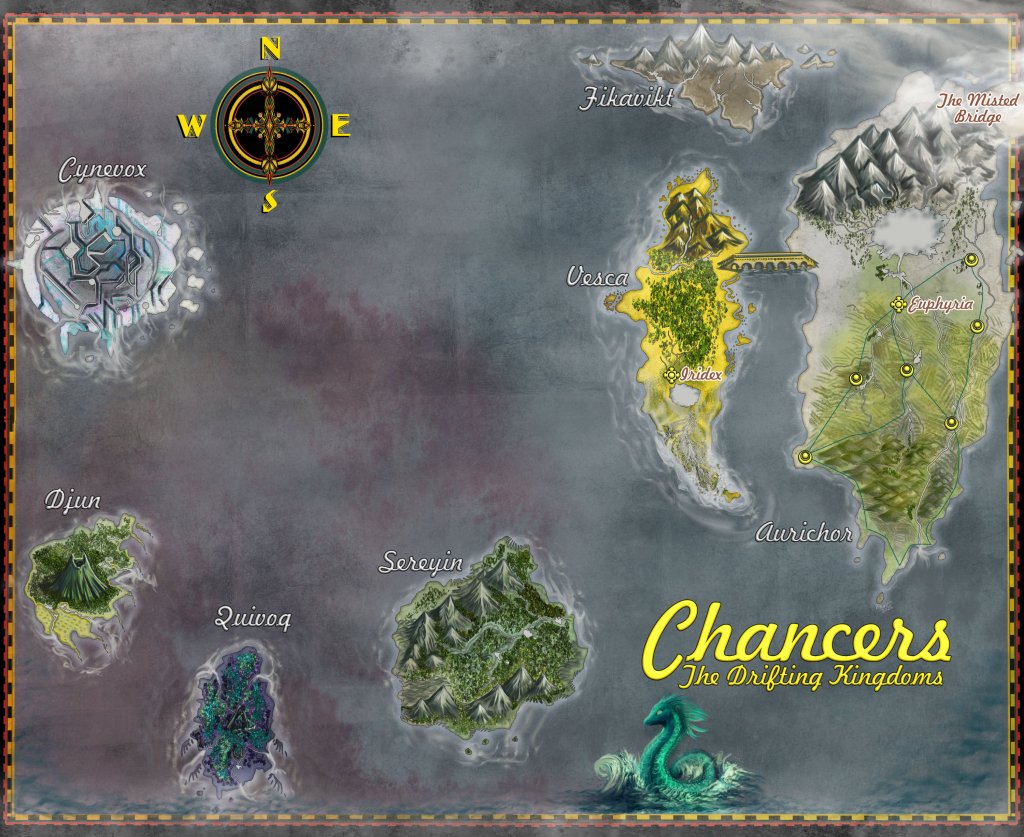
Before I dig in, let’s take a look at this beauty:

That be the map for Chancers (by the patient and kindly Ti Munro over at Feed the Multiverse), which is still slated for a crowdfunding launch this summer. If you’d like to hop on this train, your ticket to ride is right over here.

While I’m here, let me remind you that learning is terrible. Having learned is fantastic, and makes one feel like some sort of wizard, but the process is all about confronting discomfort, ignorance, and difference and coming out the better for it. Which is at least tricksy and is often brutal. It is, of course, critically necessary stuff, and often unavoidable. And in many cases it takes a few extra errors to determine that something was not, in fact, originally an error.

Lately, for instance, I’ve been revising a novella. More news on that before long. While I hope to turn the revision around quickly and get it back into the hands of a publisher, I had to wrangle with a snag: an early reader felt that my protagonist took a little too long to get on with the business of telling their story, as he lays out the causes of his reluctance to do the telling exhaustively. It took me about four variations on condensation to determine that the original hemming and hawing was probably just the right amount. He’s presented as an inexperienced storyteller dealing with slippery personal stuff, so it seems fitting to me that he’s going to dawdle a little before getting underway. I also happen to think his dawdling is engaging, and it speaks a great deal to the place he’s writing from. So in the midst of all my concessions to the wisdom of that early reader, I have tried to explain why I stuck to my guns.

I am, as it turns out, exceedingly sensitive to wasting time. When I write out hypnosis scripts, for instance, I am terribly reluctant to commit all the preliminaries to print, even though they’re critical. The needfuls generally come in during my last drafts. But I should also acknowledge my intolerance for reading and/or watching too much of a bad thing. Even after all these years I can’t handle Miss Bates in Emma all that well (the overly talkative character with little to say will always be one of my bĂȘtes noire), and while screening The Residence this past week I bristled at The Drunk Who Keeps Changing Their Story, a comedic type that belongs to the roster of liars in most detective fiction but is always hard to read or watch. Detective fiction presupposes some level of competence in the culprit most of the time, so when a story establishes that a character was discernibly drunk for most of the night when the crime went down, it’s hard to take the candidacy of that problem type seriously.

So part of me feels like I spent more time than necessary on those trial revisions, but at day’s end having a bit of evidence to suggest my narrator’s dawdling was sufficient but not excessive is a valuable thing. And the more mature parts of my brain understand that efforts to minimize errors of excess in the first draft tends to bog down the writing process and makes the prose much stiffer. That stiffness, too, is remediable, but it’s a hindrance in the first draft that also requires extra time spent in revision, a lose-lose proposition.

That’s where we’re at today, at any rate. With luck I’ll be able to put another chapter in the Completed Drafts folder for Chancers today, so it’s time to point my forehead in that direction before the deluge of grading arrives to end the spring semester.

The Fibber’s Club

Taking a wee break from work this morning to reflect on, well, work.

One of the fascinating dynamics that invariably emerges in writing fiction is the sense that some events and behaviors–all of them squarely in the Land of Make-Believe, mind you–will feel untrue. It’s not just a question of representational verisimilitude, it’s a question of epistemology, of thinking about what we believe and why we believe it.

I am deep in the woods in the revision of my novel manuscript. I went over it once not long after it was drafted, and this summer, having identified a dreamy prospective publisher, I decided to go over it again. I finished a full revision of the text just a couple days ago, and it occurred to me that only one element was awry. Without getting too spoilery or gory, let’s say I needed to be more explicit about what happened to a particular corpse, which had vanished from the site of its corpsification.

Normally I wouldn’t reckon that detail as an especially big deal; it’s the sort of blank any reader might reasonably fill in. But in this case the detail, as I’d first rendered it, involved an untruth–not just a bit of deception, but an outright lie. And that character, in the relationship as I envision and depict it, would simply not lie to the person she lied to.

So today and tomorrow, rather than writing the synopsis I’ll need to send the piece off to my dream publisher, I’m going to go to need to go back over about 300 pages of prose to make sure every instance when that subject comes up aligns with a more truthful reckoning of the event.

It’s a pain in the butt, but it’s also, I think, as sign that I’m approaching the narrative properly. There are plenty of games one has to play in fiction, when secrets, deception, and lies are all human behaviors on the exam table, but by story’s end, readers need to come away with the feeling that the writer has played the games fairly.

I know the two primary areas I’ll need to address–two accounts of the same event by different characters–but revisiting the story as a whole will give me a little more peace of mind. (This morning I recalled, for example, a minor timeline discrepancy that will need to be sorted along the way.) It’s hard not to be obsessive about the little things this late in the game. As a reader I like the experience to be immersive, with no disruptions to break the spell of a story, so going a few extra miles to make sure the reader stays within the fiction. seems like a very small price to pay for a story I love.

Better Off Betwixt

One of the perils of creative work is that ideas, even excellent ideas, are plentiful. Every now and again I’ll come across an author on my social media feeds who’s received a direct-message pitch from a stranger: a devil’s bargain of a free, totally rad idea that the writer can write so long as the pitcher can be credited and ideally reimbursed in some form or fashion. The author, for their part, usually admits that they suffer from a glut of ideas, that if they were to write 18 hours a day for the next twentty years they would scarcely catch up with their current stock. It’s something of a pleasurable peril, I think, as most folks have spells when it feels like the brain has been squeezed dry. Those stretches are, I’m glad to report, invariably temporary, and mindful writers invariably have enough zesty projects to tide them over.

This, alas, explains my current lot, as my brain appears to be stuck in the generative gear. I’m actually pretty good in fixing my noggin on a single notion and seeing it through from start to finish, but I’m also not one to turn the Muses away if they come a-knocking. The big project I’m polishing off is the novel I wrote last fall. It is, I think, nearly there, by which I mean my obsessive tendencies are nearly ready to move on. I plan to give it one last editorial pass by the end of the month, a pass in which I’ll make one foundational change and also lop off a few thousand words to get it down to what I hope will be a more digestible length. After that, it’ll be time to search for representation and start pitching the manuscript hither and yon.

While I was working on the manuscript over the summer, I also finished off a novella, which is currently in the hands of a publisher. Novellas can usually be sent directly in response to open calls, so the process is a little bit different. I also found the length terribly congenial to my way of thinking, plotting, and writing, so my brain obliged me with a string of ideas in rapid succession. Two of the three might well represent a duology, which could make for a pretty palatable single volume of about 60,000 words. The other feels like a much more self-contained experience, and after a couple of false starts I’ve finally settled into the rhythm of that piece and have it properly underway.

While four sizable projects would represent a very full hopper, it’s important to remember that I’m also something of a jackass. I’m also writing a table-top role playing game, and as fate would have it an organizational impasse happened to coincide with the launch of Eloy Lasanta’s six-week course on The Art of Gamecrafting, a joint venture of GenCon and our own CMU Press. I accordingly signed on, which will hopefully help me whip all the bits and pieces into a testable beta version. I’ve gleaned a few key insights from the class already, and I’ve also nearly convinced myself that I need to learn a few more Adobe skills so I can start making fillable character sheets. I’ve done some game writing for the good folk over at Superhero Necromancer before, but this game is very much my own jam, one that’s been ripening in my mind for several months and has a couple dozen moving parts already committed to pixels. I think some of the difficulty I’ve experienced arises from the steady diet of Kickstarters and Patreons I keep an eye on. I’ve run afoul of something akin to a stretch-goal impulse, which means I’m having a tough time sifting out what absolutely needs to be in the core game and what ought to be reserved for addenda, extensions, and optional rules, many of which I already have in mind.

Given my commitments to my teaching, I reckon that’s more than enough projects on the docket, but along the way I’ve also fleshed out synopses for two screenplays. Those probably belong on the back burner of some other stovetop, but I certainly haven’t forgotten about them. And there’s that short story I hope to get done in time for an anthology call, as well as a few revisions and reworks of older story manuscripts I need to attend to. I’m mostly caught up with life stuff, happily (today I was going to get the updated COVID shot, but I decided that I didn’t want to squander an open writing day), so I figured I’d fire off this missive to the blog and then tuck in to one of the above. Like most writing types, I’m very content to have a storehouse replete with options and prospects. But by the end of the semester, with a little luck I’ll be able to pile up some words on the pallets and ship some stuff out.

Double-Dipping

Image by Tony Detroit at Unsplash.com

Today’s post is something of a reminder to myself, as this spring I’m writing to spec a little more aggressively than I normally would. That means I’m keeping an eye out for calls for certain kinds of stories, ideally in publications that will carry the sort of cachet my university will recognize. I find that writing to spec–writing for a specific audience or venue without any guarantee the piece will ever see the light of day–keeps my creative juices flowing, and in many cases it helps me to drain my perpetually overfull Stories to Be Written folder.

I heartily recommend writing to spec when you can, especially when it seems your brainpan feels a little on the dry side. But I offer that recommendation with three asterisks.

First, try not to force it. I tend to do well under deadline pressure, and my mind likes to tweak, twist, and recombine ideas, which usually means I can come up with a good fit for a collection or a special issue on fairly short notice. There are times, however, when I recognize that my idea isn’t especially interesting or original, or when the topic involves an expedition well outside my wheelhouse. Sometimes it’s energizing to face and embrace that sort of challenge, but it’s also worthwhile to recognize that there are stretches in our lives when we’re just not ready. If you fiddle with an idea or start drafting a story and it just doesn’t seem to be working for you, it’s well worth saving the file and setting it aside for some other time. and you can be sure that another call for a special issue is somewhere on the horizon.

Second, going in it’s worth knowing that even a very fine story might not find a home at the destination you have in mind. This piece, for example, was written in response to a specific call, but the length of it, my sense that I didn’t have many profitable ways of expanding it, and a few other variables made me realize I’d probably have a hard time revising it or finding a home for it elsewhere. It’s not a bad idea to write with open eyes, knowing that your story (while tailored to a specific call) is best left open enough to travel well. One collection I’ve submitted to, for instance, has received 240 entries for about ten spots, per the editor. I wrote that story, however, with enough circumspection so that I can put it back into rotation easily if it doesn’t fit into one of those vacancies. It’s determinedly tailored to suit the needs of the collection, but it stands well enough on its own that I think it will find a spot in a different venue somewhere down the road.

And with that in mind, it’s a good idea to maintain a hopper so that you can sit on a story that doesn’t fit a given collection or special issue for a little while. In the case above, more than 200 writers are going to be left with 200 stories that are focused on a given topic, a given theme. Those pieces will flood the submission market as soon as the special issue is filled. Lots of editors are going to see lots of stories that look a little same-y. Knowing that’s going to be the case, I plan to set my submission aside for several months if it’s not accepted. I’ll revisit the piece to see if I can slough off any content that was tailored to the venue I had in mind, and with luck fresh eyes will sharpen and brighten the story. It doesn’t guarantee I’ll get the piece published somewhere down the road, of course, but I hope it will translate into fewer pieces finding their way into The Folder of Misfit Stories.

Respecting the Reader

Photo by Pierre Bamin on Unsplash

Not long ago I finished a draft of a novel, and I plan to leave it in the hopper for a few more weeks so that I can look at it with fresh eyes when I’m between other writing deadlines. The manuscript is far too long, a bit over 115,000 words, but by the time I’m done revising it I expect it will be closer to 95,000.

In On Writing, which is a lovely and valuable guide, Stephen King recommends trimming by about 10% from the first draft to the next. In most cases, however, I find I can trim quite a lot more because of two pronounced tendencies of mine: I tend to use quite a lot of apposition, and I tend to overexplain the narrative state of affairs to the reader. Apposition is something of a stylistic tic for me. It’s never a pure echo or simple repetition, but an effort to add depth and tease out nuance. I’ll certainly snip away some instances of it, save a few words here and there. The real word-count savings will come, however, when I lop off slabs of prose I added to guide the reader.

That’s a hard habit to break. As a professor, part of my job is to reach both seasoned and less experienced readers, so that we can all take a long look at craft. I routinely loop back and recap so that folk can see where we’ve been and where we’re going. As a reader myself I often lean toward mysteries, where I know full well that clues are hidden away in bits of exposition. While it’s perfectly fair game to slip in a single surreptitious hint and never mention it again, I tend to enjoy the reading experience more when missing some critical bread crumb is not the end of my engagement with the game. The authors I like best tend to present the same clues in different guises, so the conclusions their detectives finally draw are foregone, if not obvious.

Deciding what the reader needs, however, always feels to me like finicky business. As the author I always know where things are going, so it can be hard to spot those moments when a little extra connective tissue would do the reader a world of good. At the same time, too many callbacks to passages past can make reading feel like a chore, or–the far greater sin, in my opinion–make the reader feel as though the author doesn’t trust them enough to piece the sequence together.

When I revise this time around I’m going to try to err on the side of respecting the reader, clearing away some of my overgrown attempts to steer them down the main trail. I hope that by doing so I can gently encourage them to look around and enjoy the prose a little more, trusting that the path will still get them to the end, even if they have to cross a few grassy patches. So that’s my little takeaway for the day: when in doubt, cut–but save the file before you do, just in case.

The Only Way Round

Like most humans/humanoids, I go through fertile and fallow periods. For long stretches my head is intensely generative and creative, snatching up stuff from the aether and turning it into something substantive. Like most humans/humanoids, I’ve also found it challenging to navigate These Uncertain Timesℱ. Some days I’m grateful for the distraction of a pending obligation or project, but on others I struggle to muster the requisite energy to get even a little bit accomplished. Because I’m a high-functioning weirdo, however, I often have enough oomph to wake up and get what needs doing done.

One consequence of These Uncertain Timesℱ, however, has caught me by surprise: for the past three months or so I haven’t really daydreamed, haven’t really fantasized, haven’t really flexed any imaginative muscles in a conscious, purposeful way. I should probably qualify that a bit for clarity: I’ve planned and schemed and executed a few designs, but not much is happening on the ideational front. When I stare at the proverbial stucco, not much is going on. Nothing new intrudes and asks for my attention.

That might seem like a strange claim to make, but it’s one I’m confronting today. In sifting through my Big Folder of Percolating Projects I realized the latest new entry is dated September 24th. I spent much of the time between then and now chipping away at the novel, of course, but in the early part of the writing process my mind was routinely coming up with oddities that got stuck in my cognitive craw and that I jotted down for later use. These days, that’s not often true. It might be that I don’t see much on the horizon to look forward to in the near term, and it might be that my brain has exhausted most of its usual objects. Without a little challenge, change, or provocation, even the spiciest fodder can seem a little stale.

Because this is a writerly blog, however, I think it’s worthwhile to squint hard enough at those clouds to spot the silver lining: The Big Folder of Percolating Projects is a real thing, and at present I’ve got about sixteen fresh-ish ideas to work with and build on. I’ve got older notions foldered away here and there to tide me over as well, enough to ride out several months in the bunker. As a takeaway life lesson, then, my avuncular advice is to keep on hoarding and storing–to sock away plenty of stuff to work on when the Idea Fairies aren’t visiting quite as often as you like. The writing life involves more than a little patience as we see things through from start to finish, and if we find a few stray seeds when we’re tending to the old growth, it’s not a bad idea to pot them up, stow them in the hothouse, and see what’s sprouted when better weather comes around.

Potatoes and Molasses

Let us first enjoy one of the more delightful musical productions of the 21st century:

And now let us speak of narrative craft.

Over the past several months I wrote my first novel, completing it on December 14th, just a couple of weeks off my projected schedule. Right now the manuscript is languishing in a drawer (and on about 19 backup USB drives), and I’ll revisit it when I can look at the story with relatively fresh eyes.

In terms of composition, perhaps the most useful thing I did was allow myself to Draft Deliciously, by which I mean self-indulgently, quieting the inner editor who would prefer that I pause and hammer at every word choice and syntactic gesture until I’m convinced that I have it more or less right. You can see a good example in that last sentence: the existence of “thing I did” offends me, but it’s better to get the essential idea down and move along than to sit staring at the screen for five minutes trying to decide if “strategy I adopted” or “element of my approach” will appease my authorial superego, who’s kind of an ass.

What that means, practically speaking, is that my first editorial run will involve more cornstarch than anything else. And cornstarch, in this context, is all-purpose thickener, any additive one might use when the gravy is a little bit too watery. (You know what else you can use as an all-purpose thickener? Instant mashed potatoes. See how I brought that around? They hand out doctorates for that.) For instance, in plenty of places I signal the tone of a moment with a simple expression or gesture: the word “smiled” appears 83 times total in my novel, alongside 26 occurrences of “grinned.” (To my credit, characters only “beamed” twice.) It’s a long document, about 117,000 words in the Delicious Draft version, but those sorts of cues always seem lazy to me. When I go back in for the first edit I’ll do my best to signal emotion with contextual cues to indicate fitting feelz. Instead of “Cordelia smiled,” you’ll get “Cordelia splashed a little Irish cream in her hot cocoa, stirring it in and appreciating the delicate clink of the spoon against the sides of her mug.” I won’t dispense with “smiled” entirely, of course, but I’ll try to use it more sparingly if I’m able to convey the tenor of a scene without leaning on it as a placeholder.

You can probably see the problem with that approach: the manuscript is already overlong, and adding cornstarch and/or instant potatoes will add a couple thousand more words. I’m actually fine with that–but the risk involved is that I’ll bog the novel down with gestures of that kind, the molasses I prophesied back in the header. I don’t have an easy answer for addressing those excesses at this point, and I know already (based on notes to myself I’ve jotted down over the past two weeks) that I’ve got to add a little content here and there for clarity. Plus it’s a horror novel, so I’ll be splashing a few buckets of blood on certain scenes as well. The standard length of a horror/dark fantasy novel (he said, reaching out from a landslide of asterisks) is about 75,000-100,000 words, so I’ve got more than a little work in front of me.

I know that the last run of revisions will find me giving my superego free rein as I Edit Ascetically. With luck that more murderous version of your friendly neighborhood bald man will be vicious enough to whittle the manuscript down into fighting trim. In general I have a healthy mistrust of Future Me, who has historically been fairly unreliable, but I have reason to believe I can at least depend on that guy to be an unrepentant jerk.

Leave Them Laughing

(As promised over on the Fiction page, this is the first of the Wiggedies, unpublished stories that I like too well as they are to change. I thought it would be a fine representative piece to get the site up and running. I hope you enjoy it!)

Alisha glanced at the slab and squinted at Rich suspiciously.  “What exactly am I looking at?” she asked.

Rich hid his face behind his clipboard, and Alisha could tell he was trying hard not to laugh.  “These,” he said with great seriousness, “are the mortal remains of James Jurowski, better known as Jiminy Sprinkles.”

Alisha glanced at the slab again and pursed her lips.  “Rich, this is a cake,” she said.

Rich doubled over, his palms on his thighs, a fit of laughter overwhelming him.  It took him a full minute to get it out of his system and catch his breath.  When he looked to Alisha again his eyes were watering.  “I know,” he wheezed.  “Can you fix it?”

Alisha studied Jiminy.  The face, a hyper-realistic rendering of a classic clown in red and white greasepaint, had been mauled.  Four ragged lines began at the brow and raked diagonally downward, tearing through layers of frosting, fondant, and sponge.  One eye had been torn in two, and the clown’s nose had ruptured and was leaking raspberry jam. 

Alisha frowned, nodded, then indicated the ventriloquist’s dummy perched on a stool beside Rich.  It was dressed like Jiminy, from its miniature conical hat down to its own floppy red shoes.  “And what’s that for?” she asked.

Rich clamped a hand over his mouth, and his whole body shuddered.  “That’s Bitsy Sprinkles,” he managed, tears streaming down his cheeks.  “He’s here to supervise.”

It took Rich a long time to compose himself, and by then Alisha was well into the work.  She began stirring, whisking, and mixing straight away, collecting flecks of fondant and frosting to recreate the colors, and Rich pieced the story together as far as he was able. 

Jiminy Sprinkles, he had been told, worked for Currier and Croft’s Circus, and during the evening’s show a lion had swiped at Jiminy as he danced by, chased by a pack of skirted poodles.  Several spectators called for an ambulance, but by the time the EMTs arrived the strongman had hauled Jiminy out of the tent and the ringmaster had announced he was just fine—the mauling, he claimed, was part of the act.  Although the EMTs asked around there was no clown to be found, but they were paid a thousand dollars apiece to deliver the cake to the funeral parlor.  That’s all Rich could say for sure.

The EMTs both believed the mauling was a put-on.  They saw no evidence of an animal attack, no blood in the sawdust or on the lion’s paws.  It was the clown’s twentieth anniversary with Currier and Croft, they learned, so they assumed it was just a gag to get the circus a little ink in the newspaper.  The anniversary also explained why they had a full-sized cake on hand.  Some prankster must have clawed the frosting as a joke.

Rich had his own theory.  “I bet they’ll bury the real Jiminy Sprinkles out in the woods somewhere,” he ventured.  “If a mauled body was brought to the morgue they’d have to put the lion down, wouldn’t they?  I doubt a traveling circus could take a hit like that.”

He kept talking as Alisha reassembled Jiminy carefully, almost reverently, losing herself in the work.  She molded a new eye from gelatin, closed the gashes in the fondant, refilled the nose with fresh jam, and blended buttercream and food coloring until she matched every shade of frosting on the clown’s painted face.  “I probably shouldn’t ask,” she said, “given what you’re paying me, but why did they turn to a funeral home to repair a cake?”

“It’s weird,” Rich admitted, “but it looks like they have an account with us already.  We handled arrangements for a trapeze artist six years ago, and Currier was apparently impressed with our willingness to accommodate their requests.  My guess is they just like that the boss doesn’t ask questions if a client pays in cash.”

Alisha finished up at half past midnight.  She circled Jiminy and nodded, satisfied.  The reconstruction was perfect.  Rich whistled.  “He looks terrific, Lish,” he said, “and I’ve seen some amazing repairs in my day.”  She offered him a beater, which he licked greedily. “That’s one delicious clown,” he added.

Together they lowered the cake into a mahogany casket, which struck Alisha as ridiculous.  Rich, however, shrugged it off.  “I don’t think we’re actually meant to bury it,” he said.  “We’ll just replace the lining if any frosting gets on it.  There’s a viewing for family at ten, a public wake at noon.  I’m sure they just want to snap a few pictures of Jiminy lying in state.  Feel free to come back—it should be a hell of a show!”

And Alisha did return; the whole affair was too strange to resist.  She wore a black dress just in case, but she intended to spend the hour peeking out from behind a velvet curtain while Rich patrolled the parlor.  He was in the process of taking down the signs for the viewing and preparing for Jiminy’s wake when the first and only mourner arrived through the side entrance:  a pale, angular woman draped in black.

She stood by the casket for several minutes, whispering to Jiminy.  She then made a little bow to Bitsy Sprinkles, who was perched on a stool nearby, flanked with white roses, and finally exchanged a few words with Rich.  He nodded, indicated the curtain Alisha was hiding behind, and walked the woman over.

The woman clasped Alisha’s hands, lifted her black veil, and kissed them.  She left a crimson lipstick stain ringed with white foundation makeup.  “I know our ways must seem strange to you,” she said, “but we are grateful for your work.  My Jiminy looks as handsome as ever.”  She spoke in English warmed with an Italian accent, and her voice was choked with emotion.   

“I’m so sorry for your loss,” Alisha whispered.  She was flustered by the woman’s seemingly genuine grief and, feeling more than a little ashamed for mocking the elaborate arrangements the circus had made for a cake, couldn’t meet her gaze.  “I’m glad I could give you some comfort.”

The woman lowered her veil, and Alisha thought she saw a melancholy smile or something like it.  “It’s a sad day,” she conceded, “but a day for family to gather, too, and for new beginnings.”  She squeezed Alisha’s hands.  “Will you stay for the wake?”

“Of course,” Alisha said.

The woman returned to the casket, bowed over it, and murmured some words.  Then she stepped to Bitsy’s stool, picked the dummy up, and laid it down beside the clown, tucking it carefully in the crook of Jiminy’s arm.  Finally she closed the casket and nodded to Rich, who escorted her out.

Alisha joined Rich outside after the viewing, glad for a breath of fresh air.  “That was disappointing,” he said with a sigh, “but maybe the wake will make up for it.”

Alisha stood just inside the viewing room an hour later as mourners filed in.  They didn’t look like mourners, however; they seemed more like bewildered tourists dressed for a weekend outing than grief-stricken circus folk. 

Rich greeted each arrival, and two men acted as if they already knew him.  He nudged Alisha as he passed by.  “Those are the EMTs that brought Jiminy in,” he whispered.  “They were given invitations.  That clinches it.  These people must’ve attended the circus last night—this is some promotional thing for sure.”

Alisha grew increasingly irritated as the seats filled.  The whole scene felt wrong, with solemn whispers giving way to casual conversation, with teens tapping at their phones, with children ignoring their parents’ pleas to sit still.  And though she knew it was absurd—there was nothing but cake in the casket, after all—she was becoming angry on behalf of Jiminy Sprinkles.  These people were behaving abominably, and she strode to the front of the room, intent on upbraiding them.

Alisha stood before them, almost shaking with rage, when the pale, angular woman arrived.  She passed by Rich, ignoring his whispered welcome, and glided to Alisha’s side.  She took Alisha’s hand, squeezed it, lifted her veil, and gazed into her eyes.  And Alisha at last understood; a profound, prayerful calm washed over her.  “To new beginnings,” Alisha whispered, smiling.

“To family,” the woman replied, her smile creasing her greasepaint.  And then she knocked on the lid of the casket as if she were knocking on a door, her knuckles rapping out the jaunty shave-and-a-haircut pattern Alisha’s grandfather always used. The woman held Alisha’s hand as the lid burst open and a host of clowns—an impossible, wonderful number of Bitsies—clambered out of the casket.  Alisha beamed as they overran the ill-mannered mourners, their floppy shoes slapping against the carpet, their belled wristlets jingling, their smiling faces smeared with frosting, raspberry jam, and something somewhat darker, somewhat redder.  There was screaming, too, she knew, but above it all Alisha heard circus music, frolicsome and lovely, a calliope calling her home.