On Squirreling

Today I’m trying to get into the summer closeout rhythm, which is always a challenge given the overall jankiness of life. It’s been a solid summer on several fronts, and the past week has been especially lovely because a) I finalized arrangements for the cover of the game I’m writing to crowdfund next year, b) I received page proofs for “Tiny,” a short story that will soon appear in NewMyths, and c) I defeated the final boss in Shadow of the Erdtree, which made for a pretty intense gaming experience.

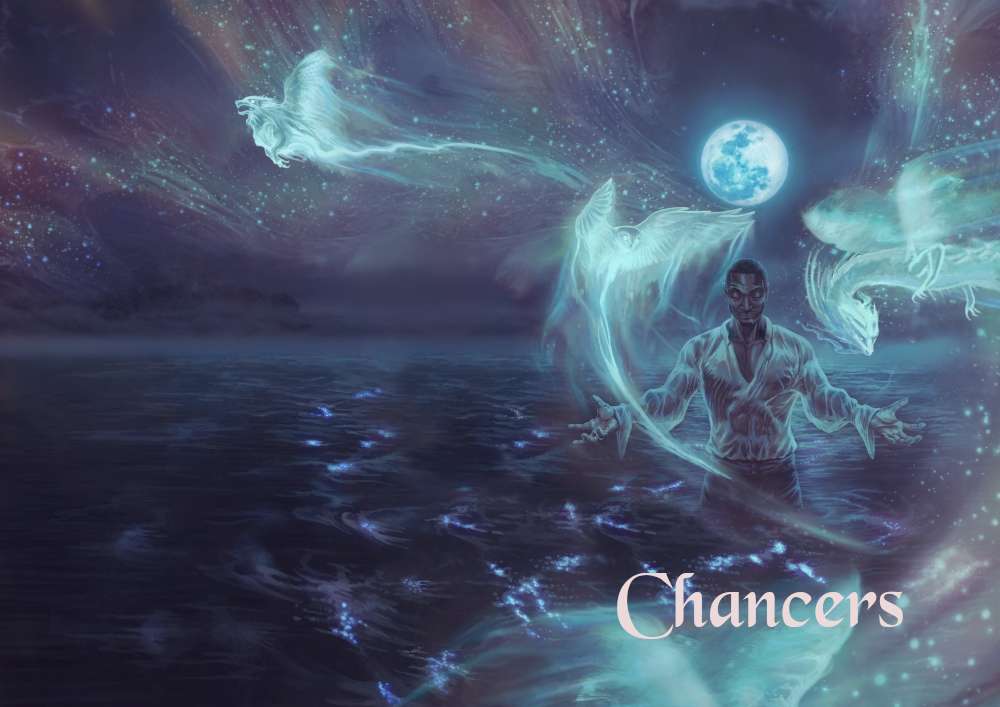
Seriously, though, just look at this beauty:

I’ll surely have a superpro graphic artist fiddle with the text, but the art is just what I’d hoped for when I commissioned André Simões, who is an absolute delight to work with.

That’s part of the challenge of summering, however–progress comes intermittently, and the writing life in general involves planting many seeds that take a long time to sprout. Chancers will be ready to crowdfund in the summer of 2025, but until then the folks at Backerkit will be periodically nudging me to build up my mailing list, which of course is not really in my control. All I can do is post the link to my peeps and hope that they’ll repost it to get it in front of more eyes. I’m working on revising my first novel, The Patch, which has taken/will take a couple of months. I intend to touch up a manuscript that has already been out in the world, a novella called The Shack, and I still need to draft another novella and hammer out the narrative logic of another novel project. This all assumes that I’m well behaved and a) don’t find myself inspired and enchanted by an editorial call for short story submissions, and b) don’t get swept up in some of the nonsense that academic flesh is heir to. Today’s tweak of the nose cone comes courtesy of yet another university asking me to do a bit of free work, evaluating the research portfolio of a professor at their school going up for promotion. For the low, low price of several hours of summer work I can add a sentence to my CV when it comes time to submit my own application for promotion a couple years down the road.

But what brings me here today are the two syllabi I’m working up for special topics courses down the road, one on romance fiction and one on fanfiction. I’m going against the grain of our recent attempts to recruit folks to our classes and the major, as we’ve spent a couple of years devising classes (Literature and Science, The Literary Interpretation of Sport) to appeal to one-and-done students who use our basic classes to check off a requirement and never set foot in an English classroom again. My preference is to try to catch the eye of folks who are already habitual readers and see if one glimpse of what our major has to offer will invite another. If all goes well, our special topics classes now (slotted in at the 300 level for the first go-round) will become 100- and 200-level intro courses a little ways down the road.

The catch, alas, is that the courses I’m pitching can be offered in 2026-27 at the earliest, since we’ve already got some folks hopping on the special topics train next year and the year after. Life these days is replete with such wanton acts of squirreling: planting acorns here and there, forgetting that I did, and seeing them sprout a long ways down the road.

Engineering Ecstasies

Like most red-blooded oversized ogrefolk, I spend a great deal of time thinking about Bridgerton. Not long ago I paid homage to the very fine writing of the recent revision of Planet of the Apes, and today I’ll offer my regards to the excellent writing bullpen of Bridgerton, especially Geetika Tandon Lizardi and Daniel Robinson, who were entrusted with bringing it all home this season.

Spoilers will follow, so avert your eyes, dear reader, if you would like an unsullied viewing experience.

I won’t dwell on the whole of the current season overmuch. Suffice it to say that the first four-episode segment delivers on some of the critical preliminaries. Our heroine, Penelope Featherington, has all but given up on landing her longtime friend/infatuation, Colin Bridgerton, following an insult she overheard at the end of the prior season. In response, however, she decides to engage with the marriage market earnestly, giving herself a makeover funded in part by the monies she’s earned as the obscenely popular Lady Whistledown.

Penelope confronts Colin with the stinging remarks she overheard, and he apologizes and offers to help her negotiate the market to find a suitable match. We get a glimpse of his sincere regret–a precondition of all that follows–and a gradual elaboration of his increasing regard for her. By the end of the first four episodes she’s entertained and rejected an excellent offer of marriage from Lord Debling. The cleverness of the situation is threefold. At one level it reveals the attractiveness of Penelope, which even the folly of Eloise (who revealed her odd arrangement with Colin to Cressida Cowper, the season’s second-place villain) can’t mess up. It introduces Lord Debling as a genuine prospect, a decent man who really sees Penelope and holds her in high regard, but who also comes with an unusual period defect (he’s a natural philosopher who won’t often be around for Penelope if they wed). And it allows Penelope to confess that someone else holds a place in her heart. And what’s key here is that we, as the reader, love Penelope enough to want what she wants, even though we know Colin, the man she would choose, can be kind of a knucklehead. He’s been on the Grand Tour of the Continent, however, and thinks himself pretty worldly. The first segment ends with Colin all but foisting a marriage offer on Penelope, which she happily accepts after a steamy encounter in a carriage. All seems to be well.

But hovering over it all is Penelope’s secret: that she has been Lady Whistledown all along, an author who has sometimes written teasingly (but always tactfully) of the Bridgerton family. Colin makes it clear that he hates this Whistledown character, and he looks forward to seeing her exposed and disgraced.

The first two episodes of the second segment circle around the issue, with Eloise in particular insisting that Penelope reveal her secret to Colin before they wed. Penelope tries her best, but circumstances intervene again and again, right up until Eloise gives Penelope a midnight deadline to come clean. (For those not in the know, the chief sticking point in this situation is that Penelope was obliged to spill some honest gossip about Eloise, noting that she was spending a little unseemly time in the business district, though in truth she was trying her best to put Queen Charlotte, who suspected Eloise of being Whistledown, off the scent.)

And the Queen emerges as the primary villain in the second half. Though we’ve been given a prequel miniseries to make her seem sympathetic, in Season Three we see her bored and petulant, angry that she hasn’t been able to identify Whistledown so far and that her newly anointed “diamond” bachelorette, Francesca Bridgerton, does not seem at all interested in the vapid marquess she’s picked out for her. (She prefers a fellow named John Stirling, even though he’s not prone to the dramatic course of courtship the Bridgertons usually follow.) Confronted with the insuperable problem of Lady Whistledown, she throws money at it–she promises £5000 (about $100,000 in modern dollars) to whoever reveals the secret to her.

So we’re in a pickle, but one that the mores of the time easily accommodates. Colin, having made the offer of marriage (and having engaged in sexytimes with Penelope) considers it his duty to follow through as a man of honor, even though he’s angry about Penelope’s double identity. Penelope, alas, exposes her secret by rushing to the press to send out a new edition of Lady Whistledown’s hottest gossip. The poor timing, however, is an issue forced by Cressida, who confessed that she was Lady Whistledown in order to avoid a horrid arranged marriage to the repellent Lord Toolbox. She writes a hasty column because she knows that Cressida will be forced to publish her own as proof that she deserves the £5000 bounty, and both she and Eloise (whose cold shoulder has begun to thaw) realize that Cressida-as-Whistledown could do a lot of damage.

The plotting on the whole is pretty complex and neatly managed, but what impresses most about the close of the season is the stretch I like to call the Shondaland Showcase, which involves a set of conventions that ends most seasons of the show. In the Showcase each of the featured players is given a chance to shine, to show themselves off in their most authentic light. It’s a tricksy bit of narrative engineering, in that (per the romance genre) the writers have to know what they can withhold till the end. A good example is the sincerity of Colin’s love. Penelope’s mother, Lady Featherington, asks Penelope if Colin actually said he loved her, and she is thunderstruck, because at that point he hadn’t. About two scenes later, however, he owns up to that love fully–tells her he loves her as a dear friend, as a delightful mind, and as a superhot sex bomb. Deferring that admission for a full four episodes would be a bridge too far, so the writers give us what we need and then add the complication of Penelope’s secret.

In the showcase, however, we get what we want to hear beautifully expressed. Penelope’s mother admits that she neglected Penelope for too long, and that she always wanted her daughters to fare better than she did. Penelope, in marrying a Bridgerton that she dearly loves, is the first of her three daughters to fulfill that wish. Queen Charlotte barges in to the marriage morning breakfast of Penelope and Colin like the Kool-Aid man, sending everyone home and insisting that she’s nearly figured out who Whistledown is because the issue defending the Bridgerton family was so neatly timed. (Cressida, helped by her mom, indeed produced an issue, but it featured nothing but the toxic “I’m just asking questions” rhetoric we’ve all come to identify with bad actors. Cressida wonder aloud why the engagements of the Bridgertons were so short, suggesting that they might just be a bunch of trollops. Compared to Penelope’s edition, which was quite gentle to Cressida, it was instantly recognized as a fake.)

Along the way Cressida tries to blackmail Penelope with the threat of revealing her secret, demanding twice the Queen’s bounty. Colin, being Manful McManley, tries to talk sense to her but botches the effort; she demands a full £20,000 to keep the secret. But Penelope has already written Lady Bridgerton and the Queen with her confession, and she promises the Queen a full explanation for her to judge at the ball her sisters are throwing (and which Penelope has secretly funded with her Whistledown earnings). Penelope delivers her speech, and the Queen (via several reaction shots) is duly swayed. It’s a brilliantly-staged set piece, made up primarily of truths about a woman’s situation in society and a promise to write even more responsibly. Colin (who in a prior scene all but pounced on Penelope in public despite refusing to sleep with her on their wedding night and the night after) recognizes and admits that he loves all aspects of Penelope, even the Whistledown thing, and not just because the Queen has all but insisted that she keep writing. So we get what we want, which is simply what Penelope wants, and we get to see her more beautiful and brave than ever.

Even John Stirling gets his own moments in the showcase, first dancing with Francesca at the wedding breakfast to help countenance Penelope’s choice to do so and to prove to Francesca that he can do the unexpected) and later delivering a toast to the whole Bridgerton family, which has accepted him despite his cold brew mode of courtship, so unlike the hot and frothy Bridgerton standard.

The MVPs of the season are, to my thinking, Eloise Bridgerton, who has to subdue her usual sparkle in order to play the devoted daughter and aggrieved friend from whom Penelope kept her secret. For us to be happy with the Showcase we need to see her and Penelope reconciled, and we finally get that reconciliation at the eleventh hour. And Lady Danbury, who scores a rare romance hat trick by a) reconciling with her brother; b) allowing him to pitch woo to Lady Bridgerton, her bestie; and c) by gently prodding the Queen, wondering if she has any plan for what she’ll do after Whistledown is exposed, wondering how she’ll live without all the town gossip Whistledown provides. And of course Penelope, who hits all the notes in her transformation over the course of the season. She was always charming and lovely, but we get to see her ravishing, despondent, and fearless as well, running us through the full array of emotions that come with the travails of the romance heroine.

And the writers stick the landing, not only teaching us what to want but delivering what we want in precisely the way we want it.
Remnants and Residue

This week, in addition to another sizable project I plan to tackle, I intend to write a short historical preface to introduce the Drifting Kingdoms, the setting for my game Chancers. It’s a tricksy kind of writing, in that it can quickly become labored, dense, and stale. Because it will inform play directly and indirectly, however, I need to get at least the basics down on paper.

In broad terms, there’s not much to it. There is an Old World era, which shares much with our common property Classical mythology of Greece and Rome. I can shorthand much of what that world looked like, since folks who play high fantasy games will have at least some of that content in their brainpans. I’m less interested in the big-picture efforts to make sense of the world (in the way that a Poseidon embodies fears about capricious oceans, for example); I just want to get down some sense of how those premises operated at the human level.

Recorded history in Chancers begins with a figure named Hereson who was, to his own thinking, a pretty dang important feller. He rose to become king of the main island in the game world, and he felt that many of his doings and decisions deserved recording. That chronicle, of course, is a partial, biased one, and it’s one that will become more and more pressurized in the rule of his heirs. There’s also a prophecy in the mix–belief that, if the line of succession lasted long enough, his progeny would rule and be remembered forever. But when the game begins his line has effectively ended, and a new line of rulers, the Orians, have replaced the Sonians. They’ve ruled for about sixty years and made plenty of changes, devising some new things, preserving some old things, and repairing much of the damage Hereson caused.

As you can see, there’s not much to the skeleton of it. I’ve got a wee bible of names to mix in, a few events sketched out, and some bits and bobs that will add color to it all. The most important thing is to pin down for players and GMs why the chancers themselves–practitioners of chancing magic–were persecuted by Hereson and his line for about 250 years. And why those chancers saw fit to bail on the Kingdoms near the end of Hereson’s life, severing the game world from everything else through the power of their magic.

In my mind the whole shebang will take about 3-4 pages of the core book, but I think it’s important to keep in mind the game within a game that most designers and writers are playing–a game players themselves are encouraged to play, too. Christian Donlan remarked on this phenomenon just the other day, reflecting on From Software and Shadow of the Erdtree. He offers a pretty vivid discussion of the piecemeal and partial experience of history we all have, which in Elden Ring is an elaborate bit of business.

As I’ve mentioned before, the outlook of Chancers is positive, optimistic, hopepunk. That means players will arrive in a world that’s functional, that isn’t in the midst of some ongoing dystopian calamity. (But there will be low-key evidence of past tribulations just about everywhere.) I’ve noticed that in most games of that grimdark nature questions about what players actually want are tabled. They can fight against injustice in limited ways, strive, and survive–they might even amass a little power of their own with which to resist the sordid prevailing order of things–but not much thought or time goes into realizing ambitions beyond that. Is there villainy in the Drifting Kingdoms? You betcha. But it’s not of a systemic, institutional kind, not a foregone conclusion, nor is it presented to players as a totalizing vision of violence. Think of the Daleks in Doctor Who, the Borg in Star Trek, or Zod in Superman; once you have those cards on the table, the kinds of stories you can tell are at least circumscribed, if not overdetermined. Hereson was maybe that kind of king, but Chancers plays out what happens when people have a chance to build stuff (or try to) instead of trying to keep it all from being razed to the ground.

In some ways the prospect is daunting, as murder is a time-honored mode of everyday problem-solving in many fantasy games. I’m not sure how folks are going to respond to a game world where they can think about a future that involves more than fending off death one day at a time, where the game within a game is tracking rations and water. I’d like to think, however, that there are gamers out there looking for precisely that kind of design. With a little luck they’ll give Chancers a look.

The Way of the Ape

Today I’m taking a bit of a break. Last evening I completed an excellent course on crowdfunding with Jason Furie of BackerKit, a class coordinated with GenCon, and I think I’ve more or less caught up on sleep after a rocky long weekend. You can still follow along with the crowdfunding campaign for my game Chancers over here, and I’ll be tucking in to about a solid month of work on the game tomorrow.

One of the things I’m especially going for in the game is the reduction of ludonarrativistic dissonance, which is the extra fancy way of talking about the tension we sometimes feel when we’re playing a game and the game asks us to do things that add a bit of grit to the system. I feel this way about grimdark games to a meaningful degree, since many of them simply position the player as a doer of grim things in order to prevent some other critter from doing things we might consider grimmer. Ideally–and in an equally fancy way–we want to engender valuative abdication in the reader or player, a willingness to let go and abandon themselves to the spirit of the story, even if it asks us to do things we might not do as our everyday selves.

One of the first lessons I learned about game design at the level of formal instruction is perhaps the most commonsensical one–design, really design, the sort of game you would want to play yourself. I had that concept duly reinforced in a prior GenCon class with Eloy Lasanta, who taught us plenty of ways to guide players at the level of mechanics. In the case of Chancers, for instance, I’ve never been particularly inspired by the Murder Is Learning model of progress in most games (which I say after about two hours of murder to get ready for the release of Shadow of the Erdtree). Because I want a game that is more hopepunk than grimdark, I designed a scheme for Reputation that opens up quests based on the prosocial behavior of the characters. Rather than navigating a world of corruption, decay, rot, and ruin, they find themselves in a world on the upswing, where their positive contributions give them a chance to encourage the outcomes they want to see in the world. I think that’s a sort of role-playing prospect we don’t see all that often, as the game sphere likes to pit good against genocidal evil in fairly stark zero-sum terms.

What does this have to do with apes? Quite a lot, really. I think the sort of distinction I have in mind is vividly realized in the difference between the first reboot of Planet of the Apes, Tim Burton’s 2001 edition, and the narrative arc that begins with Rise of the Planet of the Apes (2011), which might feature some of the best screenwriting I’ve ever come across. Spoilers abound in the paragraphs to come, so reader beware!

Burton’s film features Mark Wahlberg as Captain Hotshot Contemptington (I’m pretty sure), an astronaut who is currently awaiting for simian testing to conclude so he can ply his maverick ways in some hardcore space flight. We’re introduced to him as he does the classic jerk move with one such ape, Pericles, who is meant to pilot a shuttle to probe an electromagnetic storm. He pretends to have a treat for Pericles and asks the ape to guess which hand it’s in, but of course he has no treat. If we didn’t understand how to read that sort of game, one of the primatologists on the mission tells Wahlberg that it was an uncool thing to do. Pretty soon, of course, Pericles is lost in the aforementioned storm, and Wahlberg hotshots right in there to find out what happens.

What happened, as it turns out, is deferred until late in the movie. What happens, however, is that our hotshot pilot crashes on a planet which, luckily enough, has an atmosphere he can breathe. He soon learns that the planet he’s on is run by apes, and–for reasons Burton or the writing team don’t dwell on–the apes in question have taken on a simplified form of speciesism that looks a lot like racism. The script is a mess, but suffice it to say that the writing team wants us to side with Wahlberg but gives us no reason to. He rejects the smug superiority of the apes because he’s smugly superior himself, and even though he seems to take a shining to the progressive ape played by Helena Bonham Carter, it’s awkward and not especially believable. He finds himself caught up in what seems like a scheme to liberate the humans, but in reality he just wants to get to the site where his sensor picks up a beacon from his old ship. Some of the folks who accompany him thinks he has their welfare in mind, but it seems all he wants to do is skedaddle.

I did my best to buy in, but ultimately I ended up playing a game on my phone for most of the movie’s runtime. At bottom I simply didn’t care what happened to Wahlberg’s pilot, nor was I invested in the writing team’s awkward exploration of race relations through species relations. Burton’s apes arrive at racism as if it were a logical extension of apes possessing intellectual gifts and not a very specific cultural formation of our modern era predicated on a number of catalyzing historic conditions. It’s a time-saving move but a dumb one, as we don’t get to see how the apes formed cultural sensibilities that made them all militaristic racist jerkbags. There’s a basic line of desire in the film–we want to see apes relating to human in a non-exploitative way–but we understand that Wahlberg’s pilot is poorly equipped to usher that age into being.

The more modern arc is brilliantly realized in the new sequence–Rise of, Dawn of, and War for the Planet of the Apes. Instead of clumsily exploring racism via an underqualified white savior, the movies instead center on the moral formation of Caesar, the ape leader played by Andy Serkis. At every step–and I do mean every step, almost literally–the screenwriters, Rick Jaffa and Amanda Silver, teach the viewer what to want. The lines of desire are vivid and sensible. When Will Rodman, a chemist, wants to move from animal trials to human trials for his Alzheimer’s treatment, he meets with disaster. The chimpanzee on whom he’s pinned his dearest hopes, Bright Eyes, erupts in violence on the day when the pitch for the next stage of the experiment was to be made. We soon learn, however, that she’d given birth, and that her violence was little more than an effort to protect her newborn. (I like to think the failure to notice Bright Eyes was pregnant was a bit of snide commentary on the myopia of the techs, but there’s not much meat on those bones.) All the other apes in the trial are euthanized, as the pharmafolk assume that the violence was a side effect of the drug, but the lead veterinarian can’t bring himself to euthanize the newborn. He hands off that job to Will, which is the first domino to fall. Of course we don’t want to see the adorable wee chimpanzee killed, and the next scenes find Will taking the chimp home and teaching him, caring for him like a doting father. We also get to see Will move on to human trials with his own father, who is suffering from Alzheimer’s himself. It’s the sort of recklessness the viewer can roll with because we want to see the father recover; it’s not recklessness justified by a pilot’s desire to do cool pilot stuff.

Things go reasonably well until the chimp, named Caesar, gets some exposure to the wider world. He is effectively a rebellious teen who wants his freedom, which goes against the grain of Will’s need to keep his illicit experiment a secret. Soon that secret gets out, and the writers hit us with two whammies: we learn that the father is becoming resistant to the drug, and we learn that the updated version of the drug (which the pharmafolk hasten into production) has more disastrous effects on humankind. An assistant dosed with it gets sick, and he soon coughs up blood on a pilot. The cleverness of the film is that we’re deeply invested in the welfare of Caesar and later Koba, the test chimpanzee for the new drug variant. Even though we realize that the effect of the drug is contagious and will likely eradicate humankind, we’re still on board as long as things turn out well for Caesar. Serkis’s performance, coupled with our awareness that the problems were ultimately man-made, yields a rare apocalytpic mulligan.

And what happens in Dawn of and War for doubles and triples down on the lessons we’ve learned and desires we’ve hatched. At every turn the writers strum the strings, letting us see how Caesar’s nobility is worth preserving and exploring. What Caesar wants, at least initially, is a benign separation, a distance from the humans he quite reasonably mistrusts. But he’s not wholly averse to humans; he just prioritizes the welfare of his apes. And though the story entangles his fate with the fate of humans again and again, we arrive (by the end of War) at a glimpse of something that looks wholesome and optimistic–a second-generation wave of illness for mankind that arrives just before the apes make their way to a glimpse of their own promised land, well away from the arena of human conflicts.

This post feels overlong, but even so I’ve overshot about fifty subtle and unsubtle inflection points, places where the writers let us know what we might want and why we should prefer certain outcomes over others. And it’s seldom a simplistic picture–they make clear that Caesar’s nobility is not a trite, trivial thing, but a batch of qualities that is challenged and tested. The home stretch of War is especially astute, as Caesar overcomes his desire for vengeance after struggling with the impulse for the lion’s share of the film’s duration. And at day’s end he’s shot by a human to whom he showed extraordinary mercy and rescued by an ape that had aligned itself with the humans, convinced he had chosen the winning team.

Understood in that light, what I’ve done with the design of Chancers seems simplistic; I’ve created a mechanic for Reputation that opens up hundreds of ways for players to realize the ambitions of their characters but discourages violence and mayhem as a recourse of first resort. The scale only goes up, with a dozen tiers; going below zero, as it turns out, puts the players on the radar of the authorities and causes some sociocultural doors to close. In a game world that is, as it turns out, largely functional, it seems deeply problematic to encourage a play style that centers on murder and looting. There’s genuine peril to be had, of course, but it’s out in the wilds of the game world, where different principles hold sway. And even in the safety of the capital city there’s adversity to be had, enemies to fight, and danger to face. But there is stuff worth fighting for, too, which is I think where most of the grimdark games miss the boat.

Visions of the Future

It is a truth universally acknowledged that a bald man who does not have at least five juggling pins in the air is prone to think himself idle and get into trouble. I’m accordingly delighted to announce the fairly distant crowdfunding drive for my TTRPG Chancers, which is currently slated for next May, at least at the moment.

Head on over to the BackerKit landing page, sign on, and keep up with all the details as they develop. If all goes well, I’ll be announcing the commission of a cover artist and a cartographer soon!

Adjustments

I’ve had a tough time gearing into my summer plans, in part because I didn’t give myself much downtime before tucking in to a summer class on crowdfunding and in part because I decided I needed to wean myself off the sundry supplements that seemed to be alleviating my longstanding headache symptoms. I’ve got a goodly amount of gas in the proverbial tank, but I often give myself a quiet week to say goodbye to the past semester and to fill up my summer docket.

I usually comfort myself by fixing on what falls to me–the little things I can do for me and mine to keep the old wheels a-turning–but there are days when the curves keep coming. Last night, for example, my fiancee woke me in the wee hours, as our CO2 alarm was going off. Happily, the alarm was just alerting us to the end of its sensor life, but it kept me away from an hour of badly needed sleep all the same. To add to the merriment, I dreamt of plumbing leaks last night, one of those low-key concerns of homeowners all over. But I had enough clarity when I woke to realize that the layout of the house I dreamt of did not resemble the Abbey itself.

It’s astonishing how much we can adjust to, however. It hasn’t taken long for my body to adapt to the new schedule, and once I rounded the corner and started thinking earnestly about my crowdfunding plans, the pieces started falling into place reasonably well. My body was a jerk for a couple of days, but now it seems it’s getting used to the absence of the green drink I had every morning, which I’ve replaced with a post-workout protein shake. We’re also adjusting to some low-sodium realities here at the Abbey, as my fiancee experiences some relief from an issue that can lead to cold in her fingers and toes when she keeps her sodium down. She learned that lesson, alas, when a spider bit her toe, but that injury is finally healing, and all seems to be getting better.

The sundries of life all seem pretty banal when you think about them, which it’s generally best not to do. I had planned to get ready for PitDark today, and perhaps to see about commissioning a cover artist for my TTRPG, but I’ll probably spend the rest of the morning hunting down new CO2 detectors (which may involve shaving my head, as I look a little scruffy) and my afternoon preparing for an off-schedule grade grievance hearing. It’s all minor-league stuff, inconvenient at worst, and it might be complicated by a bit of rainy weather if I dawdle too long.

Because I’ve been thinking about my health a lot lately, I’ve been attending more closely to the welfare of my agemates. One has recently undergone surgery, and another is struggling with illness. Several friends, however, are faring very well, so I’ve been trying to focus on them, to think of them as stars to steer by. Alas, one of those stars winked out last night, as a well-loved friend just four years older than me, a man I admired for a jovial and spirited approach to the business of living, died in a motorcycle accident last night.

All the platitudes that instantly come to mind on such occasions certainly apply, but one feels their insufficiency profoundly. Not much to do but keep making those changes and attending to all the little things, so that we’re ready when the bigger things arrive.

The Vision Glitch

Today’s post is brought to you by Night Verses’ “Glitching Prisms,” which I stumbled across this morning as I tumbled down a rabbit hole.

We’re closing out spring break here in Central Michigan, and the past few days have been a little rocky. I had one of my bouts of typewriter vision just yesterday (it’s like the room is spinning, but it keeps resetting and starting back from the initial point of the spin), and I also had a double-rejection Friday as well. This follows on the heels of a dentist appointment and some scheduling lapses on my part that kept me from attending my first yoga class this week. These Wandlessian travails were amplified by the woes of my lovely fiancee, who has worked heroically all week to get herself set up to thrive this spring but kept encountering reversal after reversal.

The catch, of course, is that she didn’t exactly see it that way, which I’ve found instructive, and which spurred me to think about my own stress in a different way. The most vivid example is probably The Laser, which is pivotal because my fiancee works with a laser cutter/engraver most days. Her ambition down the road is to work primarily with ADA signage, but until she’s eligible to be a rider on governmental contracts (as contractors normally postpone hiring folks, no matter how attractive their bids and how extensive their know-how, until they’ve been in the industry for two years) she’s been using her machines for other projects. My boo, she has all that hustle.

Early in the week she spent several days aligning the optics on her machine, as she hoped it would allow her to achieve higher speeds and greater power, but at day’s end she decided to invest in a new laser tube. The scrambling to get everything sorted was of course stressful, but she was able to round her way back to an optimistic philosophical position in a matter of hours. Doing all the alignment work was not wasted, as it’s work her business will benefit from in the long run, and today she went in to the office excited to see what her newly punchy laser will be able to do at full speed. She also had foresight enough to save for the replacement, so the only real cost was a bit of time. Along the way she’s kept getting calls, including a nibble from one of the biggest contractors in the state. The wheels continue to turn for her, and that turning is aided and abetted by her ability to keep reorienting her own way of seeing in a mature and hopeful way.

In retrospect, was the past week really an Ordeal? Reader, it was not. I’ve cleared out all the items in my grading queue, for example, and I finished drafting my submission for the anthology I mentioned last time around with plenty of room to move in the revisions I attempt. Additionally, I had distinguished presses in mind for the next submissions for both of yesterday’s rejections, and this week I also read Susanna Clarke’s excellent Piranesi, which should fit perfectly into a recent sequence in my graduate class. I have great friends to play games with and great colleagues to work with, and the typewriter vision did not bog me down, as it sometimes does when I’m feeling overwhelmed and just want to take a series of interlocking naps.

I shan’t indulge on the political too much, but it’s an experience rather like the State of the Union address. I wasn’t much inclined to watch the speech on the whole, but I knew my news feed would be dominated by coverage the morning after. And from what I could tell the material was very much reflective of glitches in vision. Overall reviews tended in roughly the same direction (though the take on that direction hinged on who was offering the coverage), but plenty of people were totally fixated on about fifteen total seconds in a talk that lasted more than an hour. It’s rather like walking through an orchard and obsessing over one bruised, worm-riddled apple. It’s part of the picture, not the whole of it.

Not the freshest insight under the sun, I know, but when I run into something heartening I’d rather focus on it than dwell on the stressors that are always at hand. I also wanted to kick out an entry before embarking on this, what seems like my first uncommitted writing afternoon in 46 million years.

Blobligations

Right now, with a level of desire that verges on becoming a problem, I really, really want to work on my TTRPG and my submission for the Kanghas Khan Fear of Clowns anthology. Alas, I’ve got a bit more grading to do before spring break arrives and presents me with some sizable chunks of time, so today I’m spending my semi-free lunchtime minutes to add to the blog instead.

Today I’m thinking particularly about Academic Time, which is a peculiar thing. It tends to sprawl in odd and unexpected ways, though perhaps not odd to those folks who’ve chosen to be parents and raise kids., for whom the odd and unexpected can be the norm. Quite a lot of time is invested in students, and I view that as a pleasure and a privilege. Could I live without responding to a few of the “Did we do anything important in class today?” emails I receive each week? I suspect I could, but the fact that I get to field them speaks to a certain kind of existential pleasure.

It’s worth noting that, in terms of the administrative imagination, most professors where I work are subdivided into four units of human. Three of those units each semester are committed to teaching, and the fourth is reserved for all those scholarly and creative activities that contribute to the mission (and greater glory) of the university. The STEM folk will notice that the 3/4 + 1/4 gets us to 4/4, which means that anything else I’m asked to do must be reckoned in some more imaginative way.

The blobular time I tend to resent is academic service time, in part because it more often feels like a self-inflicted cut that’s become infected. The grodiest wounds come from spontaneous delegation, when a critter who is very well paid to take on a job decides to offload some of their responsibilities to parties who signed on for some other adjacent gig. Similarly, we experience subcommittee proliferation, when a group entrusted with some smallish responsibility decides that responsibility could be handled better by divvying up the work between several even smaller groups at their own ad hoc meetings distributed over the course of the week outside the regularly-scheduled time. Perhaps the vilest time sink, at least in terms of feel, comes from higher-order administrative tasks one has chosen to take on but which might benefit from collaboration or delegation (which is on my mind because I know a kind, skillful adminacritter who takes on oodles of work herself because the alternative is pairing up with someone who will require a great deal of management and handling). It’s often easier to do the thing oneself than beg for a collaborator to do the thing properly and on time, but that comes with a cost.

All told, this has taken me about 3/4 of a bowl of jambalaya to write, which I think is time reasonably well spent. I say this, of course, knowing full well that my WordPress host is currently in talks to sell user prose to some large language model engine to churn up and squeeze out some word sausage down the line. I win today, in that I keep the promise I made when I posted the last entry and get to tick off a box on the day’s to-do list, but I’ll probably cut my losses on the blog if I learn that I can’t opt-out of the slaughter prior to the sausage-making process. A little bittersweet, that, but rather than dwell on it I’ll think about gameplay mechanics and sweet, sweet murder-clowns.

Fables of the Preconstruction

It’s December 31st, which must mean we’re at the magical interval between Taking Stock and Resolution O’Clock. Though I’m not an especially Christmassy critter, I’m terribly fond of the prospect of annual revision and reinvention. I’d imagined that I might get a bit of a head start, as the folks we imagined we’d spend the Eve with have fallen ill, but it looks like we’ll be a bit social after all, so the rejiggering will have to wait.

I’m not fond, however, of doing year in review exercises, largely because my imagination tends to fix on What Might Have Been. It’s not an especially rueful exercise in the abstract, but it tends to get me thinking about things I might have done differently. For instance, since I often think in terms of the academic year and professional progress, I’ve published six short stories in the AY 2022-23 frame, which is life-affirming in a number of ways–not only because my university views four publications as sufficient for meeting our standards for tenure and promotion. I also have a story on the publication slate for New Myths in Fall 2024, so the wheels are still a-turning. Right now in the social mediasphere, however, I’m seeing quite a few folks tout their award-eligible work, and I’ve not yet mastered that knack. It’s not, to my thinking, a major omission on my part, but one of those matters I might want to rethink in 2024.

As a teacher, I often mull over the famous Socratic dictum on the Corruption of The Youth around this time of year: ”The unexamined life is not worth living.” Self-examination is, I know, a difficult bit of business, especially since the tactics that got us this far will undoubtedly get us at least a little further. It feels to me a little tragic when I see it from the outside–when you see folk so committed to the Truths they’ve dreamed up or borrowed from others that any other prospect seems untenable, if not ridiculous–but it also seems tragic to make change blindly and reactively, without a little due diligence to suss out the advantages that might attend A New Way, whatever that way might be. January tends to be a good month for Trial-Size Truths, with the feelings we get from abiding by those short-term commitments helping us to decide if we’d like to fold those truths into out lives. 

The end of the year is also Garbagetime for Purity Testing, as plenty of folks will try to get us to commit more fully and less mindfully to the Truths they think we ought to share–often indirectly, by criticizing public figures who are not pure enough. Because I poke around the edges of the web to look at the latest news in neuroscience, I get plenty of pop psychology to do with the business-minded Growth Mindset, citing several very rich people as proof of the virtues of that way of thinking. It’s also the time of year when folks will tell us that we need to cultivate a daily writing habit (we don’t), that we need to announce our position on several key issues (we don’t), &c. If we fail to do so vocally and determinedly, the theory goes, then we must be bad people. (I say this having just skimmed past bitter criticisms of Selena Gomez, Neil Gaiman, and Lynda Carter, all of whom have failed in the arena of public opinion, according to a few vitriolic folk, by not weighing in on international matters with sufficient vehemence.) It is, I think, Much Too Much of a Muchness, but it gives us a sense of how folk conceive of themselves in relation to weighty matters.

(Sidelong fact: one of the reasons I prefer to teach ENG 101, centered on expository writing, rather than ENG 201, a course on research and argumentation, is that it’s a great place to practice one of the most essential writing skills–convincing readers why they should care at all about what you think. We’re in a weird place as far as expertise goes, I know, but at bottom I think it’s sort of important to establish how experience has equipped us to weigh in on various matters of cultural import.)

To my thinking, preconstruction involves a bit of self-reflexive scrutiny, the gentle reconsideration of patterns and habits that clearly work but might be worth revisiting. For much of the past year, for instance, given the persistence of the Never-Ending Headache, my daily routine has begun with five pills–Vitamin D, a multivitamin, and a krill oil capsule as basics and a couple of NSAIDs to ease the dull discomfort of my skull. For the past few weeks, however, I’ve been exploring the possibility that my gut health might be linked to my brain pain in some material ways, and I’ve adjusted my startup routine accordingly. Yet today is the first day I’ve dispensed with the NSAIDs, which I suspect on some days I’ve taken merely out of habit rather than need. It’s a little thing, but a foundational one, and probably indicative of a few dozen things I do every day without really thinking about them.

For the same reason I’m thinking about reconstructing my daily docket, which has had the same top twelve items since around Thanksgiving. I’ve churned through 13-27 with some regularity, but the stagnancy of those first few suggests that I’m probably conceiving of them wrongly. My plan this year is to get a bunch of new writing done, and I’ve lined up projects big and small to keep me awfully busy from now until May. I might need to get each project broken down into smaller, more manageable daily chunks to get in the habit of making steady progress, and that will probably entail thinking about them all a little differently. It’s all doable, but figuring out how I’d like to manage the doing is the tricksy bit of business. I’m happy to say it’s already underway–one project, for example, will involve putting together a sixteen-page zine, or about eight total entries, for Kickstarter by March, and I’ve drafted seven already, page by page–but I need to find ways to keep that forward momentum going.

I’m convinced there are big things on the horizon in 2024. I don’t think I need to reinvent the wheel to reach them, but it seems wise and worthwhile to consider how I’m moving toward them.