
Circles and Circulation

Photo by Robert Lukeman on Unsplash

The last week has been fairly hectic for me, in part because it involved the run-up to Spring Break (and, perhaps less festively, midterms) and in part because it involved the kind of preparatory space-clearing needed to make something of a free-ish week. My Inner Delinquent would like nothing more than to take a deep dive into Elden Ring, but I can see enough enticing deadlines on the horizon to keep the creative gears turning.

To get myself ready I made time for a deep dive: I have seven holdover stories from the latest edition of my submission tracking guide, and I gave myself about a week and a half to revise four of them, normally with a specific destination in mind. In some cases that was simple work–trimming off a couple hundred words, and in one case adding 400–but others involved more extensive reconfiguration. It’s easy to get caught up in the zest of a fresh draft, but there’s real pleasure to be had in spending time with an old friend and seeing how it’s changed since last you met. Still happy with all those pieces more or less as they were and as they now are, and I think it’s healthy to go back and revisit old haunts, if only to see how they’ve changed and how you’ve grown.

The tricksier bit of business is owning up to unreadiness. The two remaining stories from that holdover set are, I think, pretty dang good, but at the moment the places I’d most like to send them are closed to submissions. There’s a sort of insistent impulse to send them somewhere–anywhere!–just for the sake of feeling as though I’ve got irons in the fire and many things to look forward to, but I’d rather see them sent to the best homes I can think of, even if that means waiting for another month or three.

And the same general principle applies to writing new stories, especially in response to anthology calls. I’ll often rattle ideas around in my skull for days and even weeks, but sometimes they just don’t catch (or, with an annoying degree of regularity, they emerge in an underdeveloped form and find themselves shouldered aside by far more energetic ideas with much later deadlines). An older version of me might have forced the issue, trying to write something–anything!–for the sake of maintaining momentum and good writing habits. But I think that’s a disservice to both the editors of the world as well as my own sense of what it means to write good stories. I can be prolific when I try, but I’d rather be a smidge more discriminating.

Circulation, especially during dry spells, can feel quite a bit like running in circles, trying to beat your own best time. But when it comes to writing, and to writing the best fiction I can, the clock or the calendar is probably not the instrument best suited to measuring progress.
Tracking Numbers

As someone who just spent twenty minutes following up on a step in the Public Service Loan Forgiveness proceedings at the behest of the student aid hierophants, only to be told I am not at all eligible to do the thing I was specifically instructed to do, I have fairly strong opinions about data analysis and associated forms of number-crunching.

There are, of course, useful numbers. When a story or poem is rejected, especially with kind words from an editor, it can be comforting to know that your piece was one submission out of 250, 500, or 1000. There are Clifford Garstang’s Perpetual Folly rankings, indispensable resources for gauging the relative difficulty of placing a story or poem in any given publication. And there are the numbers I track on my own computer, which tell me what percentage of my fiction and poetry I’ve published. I’m not much inclined to get too bogged down looking at spreadsheets (I just use Word documents for tracking, truth be told), but anything that offers me a sense of the overall lay of the land is valuable.

I think there are also some advantages to be reaped from a bit of amateur analysis, too. When I look at patterns of acceptance and rejections, for instance, I can usually see errata–outlier stories that I probably ought to revisit before considering starting the submission engines again. I’m currently revising just such a story, one I find quite beautiful but (to my thinking) falls in the Neither Here Nor There category. It has speculative elements, but it’s not horrific enough to be salable horror, nor is it fantastical enough to be salable fantasy. It’s a subjective assessment, of course, but I figure any evaluation that prompts me to re-imagine the shape of an unpublished story probably arises from an intuition worth pursuing.

And at bottom it does my heart (such as it is) some good to look at a chronicle of rejections that ended in an acceptance. It took me a sizable quantity of saved-up gumption to start submitting my fiction back in the day, and while I’ve landed a couple of pieces in lovely homes on the first go, I think one of the more important writerly lessons we have to learn is pure, dimwitted persistence. I think it’s more than sensible to set a piece of work aside after a dozen rejections, but the creative marketplace really is–really and truly, no foolies–predicated on that elusive quantity called fit.

The fact that a story or poem doesn’t land right away does not mean it’s garbage. It just means a single reader (perhaps a screener, perhaps the editor themself) is not picking up what I happen to be laying down. And when I imagine that uncontrollable facet of the work in those terms, I sleep a little easier at night. I just get back to telling the best stories I know how to tell, and trust in time and persistence to tend to the rest.

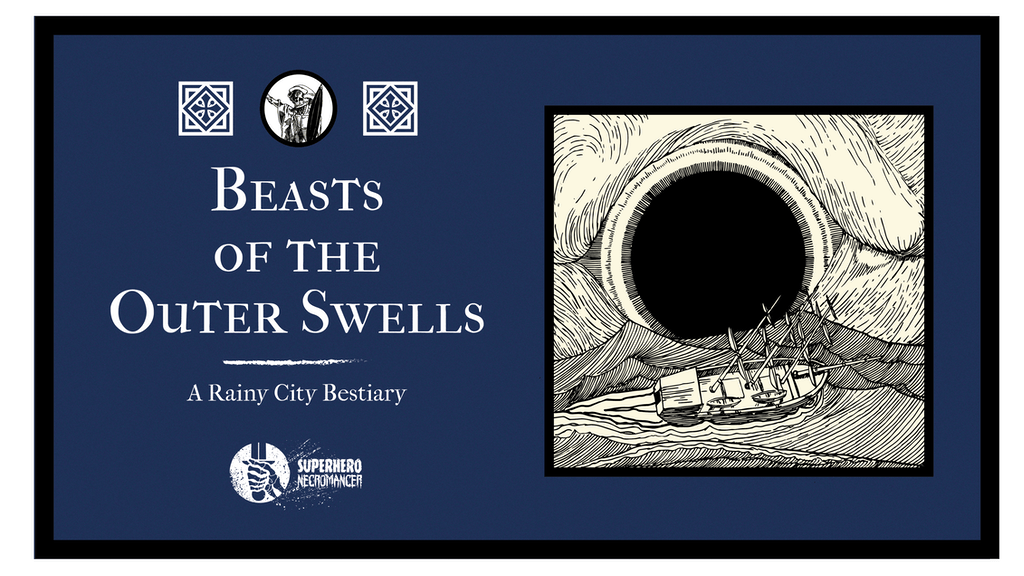
Beasts of the Outer Swells

I’m incredibly excited to be writing for the crackerjack team at Superhero Necromancer on their latest addition to The Rainy City campaign setting, Beasts of the Outer Swells. The Kickstarter went live this morning, and it’s already reached its goal, which means this nifty zine will be winging its way to mailboxes all over the world in just a few months! The images are absolutely fantastic, and if you fall in love with the art, be sure to pop over to the site of the artist, Bill Spytma, where you’ll find even more of his portfolio. (Prints can be had at Society 6 as well!) Writing for games is a real treat for me, and if you’re into whimsy, weirdness, and a bit of the wicked, The Rainy City it might just be your cup of tea!

Double-Dipping

Image by Tony Detroit at Unsplash.com

Today’s post is something of a reminder to myself, as this spring I’m writing to spec a little more aggressively than I normally would. That means I’m keeping an eye out for calls for certain kinds of stories, ideally in publications that will carry the sort of cachet my university will recognize. I find that writing to spec–writing for a specific audience or venue without any guarantee the piece will ever see the light of day–keeps my creative juices flowing, and in many cases it helps me to drain my perpetually overfull Stories to Be Written folder.

I heartily recommend writing to spec when you can, especially when it seems your brainpan feels a little on the dry side. But I offer that recommendation with three asterisks.

First, try not to force it. I tend to do well under deadline pressure, and my mind likes to tweak, twist, and recombine ideas, which usually means I can come up with a good fit for a collection or a special issue on fairly short notice. There are times, however, when I recognize that my idea isn’t especially interesting or original, or when the topic involves an expedition well outside my wheelhouse. Sometimes it’s energizing to face and embrace that sort of challenge, but it’s also worthwhile to recognize that there are stretches in our lives when we’re just not ready. If you fiddle with an idea or start drafting a story and it just doesn’t seem to be working for you, it’s well worth saving the file and setting it aside for some other time. and you can be sure that another call for a special issue is somewhere on the horizon.

Second, going in it’s worth knowing that even a very fine story might not find a home at the destination you have in mind. This piece, for example, was written in response to a specific call, but the length of it, my sense that I didn’t have many profitable ways of expanding it, and a few other variables made me realize I’d probably have a hard time revising it or finding a home for it elsewhere. It’s not a bad idea to write with open eyes, knowing that your story (while tailored to a specific call) is best left open enough to travel well. One collection I’ve submitted to, for instance, has received 240 entries for about ten spots, per the editor. I wrote that story, however, with enough circumspection so that I can put it back into rotation easily if it doesn’t fit into one of those vacancies. It’s determinedly tailored to suit the needs of the collection, but it stands well enough on its own that I think it will find a spot in a different venue somewhere down the road.

And with that in mind, it’s a good idea to maintain a hopper so that you can sit on a story that doesn’t fit a given collection or special issue for a little while. In the case above, more than 200 writers are going to be left with 200 stories that are focused on a given topic, a given theme. Those pieces will flood the submission market as soon as the special issue is filled. Lots of editors are going to see lots of stories that look a little same-y. Knowing that’s going to be the case, I plan to set my submission aside for several months if it’s not accepted. I’ll revisit the piece to see if I can slough off any content that was tailored to the venue I had in mind, and with luck fresh eyes will sharpen and brighten the story. It doesn’t guarantee I’ll get the piece published somewhere down the road, of course, but I hope it will translate into fewer pieces finding their way into The Folder of Misfit Stories.

Content/Contented

To begin, a confession: I’m pretty terrible at self-promotion. I’m somewhere on the introverted half of the spectrum, as many writers are, and I’m also afflicted with a strong sense that lots of the content we are bombarded with in our daily lives is unwanted. So my strategy for the moment, such as it is, is to keep on posting here–what the kids call Contentâ„¢–so that readers who find me have somewhere to go if they want to see what sort of mischief I get into.

There is some fine guidance on managing the daily work of self-promotion out there, to be sure. Not too long ago Sadie Hartmann–known to many on the webz as Mother Horror–posted this super handy guide to navigating the wilderness of social media, and I’ve come across others here and there. Like any aspect of the writing life, however, one’s presence on the internet as a Hawker of One’s Own Stuff probably ought to involve a little calculation and circumspection. Back in the day I hosted a blog that I posted to daily, and I had a respectable number of regular readers. At day’s end, however, I realized that my blogging time was obviously digging into the time I needed to devote to fiction and poetry, so I had to let it go. Nowadays I hope/intend to strike a better balance, with a post here two or three times a week, posts to Twitter several times times a week, and the rest of my time devoted to my work. I’ve started off the year well, with two short stories already in the books and some writing for a game project already in polished draft form, so it seems to be a balance that suits me. The trick, of course, is finding the balance that suits you.

I’ll add to these thoughts on content a little ways down the road, but for me–at least today–it’s something like an exercise in mindfulness. I’m trying to be a little more deliberate and reflective this year in terms of what I do and how I do it, and if I chance upon any discoveries or unriddle any mysteries along the way, well, you’ll find them here first.

On #Feelz

Photo by Gary Fultz on Unsplash

Today I am roaming a strange corner of the Feelscape, having risen to the news that my application to join the Horror Writers Association was accepted. I’ve got a few degrees, which is nice, but I’m also a certified mixologist, a certified hypnotist, and an authorized horror. Expect more from your neighborhood weirdo.

Because the better part of the speculative fiction writing life consists of staring at a monitor and hunting down synonyms for squamous, such recognition is a lovely thing. I’m not in the business of ranking my feelings, but crossing over a professional threshold like HWA membership certainly falls somewhere in the vicinity of publishing a story or finishing a project. These are the writerly highs we can rely on.

But today I’m also enjoying a writerly feel that often strikes me as equally rare: the one that comes from rescuing a draft breaking bad. On my desktop I’ve got a ridiculous and conspicuous array of folders I deperately need to organize (Writing Priorities, Creative Writing, On-Deck Projects, Works in Circulation, Works in Progress, and Pieces to Work Up among them), but somewhere I dare not mention I have a folder that harbors my secret shame–those stories that are finished, by which I mean written from beginning to end, by which I mean gone too far for me to fix. At some point I’ll extract the core idea and begin again, but in the case of such stories the repair work calls for much more than insistent revision, which can sometimes salvage a draft from matters of defective tense, perspective, et cetera. The inhabitants of this Island of Misfit Stories involve some error I made at the outset that conditioned the entire draft, and while I can cannibalize passages for sexy turns of phrase I have to concede that the story in its current form is a lost cause.

So it’s a rare relief–or perhaps even a sign of something like maturity–that this morning I looked back at the first 500 words I’d written for Blood Rites Horror’s For Whom the School Bell Tolls anthology and realized the story in its emergent form wouldn’t get off the ground. There was nothing fundamentally wrong with the prose I’d committed to pixels, but I recognized an early commitment I’d made, exploring the psychology that motivates my main character, was bound to yield a certain kind of epiphany at the end. It would have made for a good story, I think, but not one with the effects I intend. I have the bad habit of trying not to waste prose if I can help it, but scrapping what I had and beginning again with a clearer sense of what I need is not a waste at all. It’s a necessary step for writing the finest story I can imagine.

It’s perhaps not the feel I’d most like to have on a Tuesday, but it’s an entry in the catalog of #feelz I’m learning to respect more and more as my writing life unfolds.

Respecting the Reader

Photo by Pierre Bamin on Unsplash

Not long ago I finished a draft of a novel, and I plan to leave it in the hopper for a few more weeks so that I can look at it with fresh eyes when I’m between other writing deadlines. The manuscript is far too long, a bit over 115,000 words, but by the time I’m done revising it I expect it will be closer to 95,000.

In On Writing, which is a lovely and valuable guide, Stephen King recommends trimming by about 10% from the first draft to the next. In most cases, however, I find I can trim quite a lot more because of two pronounced tendencies of mine: I tend to use quite a lot of apposition, and I tend to overexplain the narrative state of affairs to the reader. Apposition is something of a stylistic tic for me. It’s never a pure echo or simple repetition, but an effort to add depth and tease out nuance. I’ll certainly snip away some instances of it, save a few words here and there. The real word-count savings will come, however, when I lop off slabs of prose I added to guide the reader.

That’s a hard habit to break. As a professor, part of my job is to reach both seasoned and less experienced readers, so that we can all take a long look at craft. I routinely loop back and recap so that folk can see where we’ve been and where we’re going. As a reader myself I often lean toward mysteries, where I know full well that clues are hidden away in bits of exposition. While it’s perfectly fair game to slip in a single surreptitious hint and never mention it again, I tend to enjoy the reading experience more when missing some critical bread crumb is not the end of my engagement with the game. The authors I like best tend to present the same clues in different guises, so the conclusions their detectives finally draw are foregone, if not obvious.

Deciding what the reader needs, however, always feels to me like finicky business. As the author I always know where things are going, so it can be hard to spot those moments when a little extra connective tissue would do the reader a world of good. At the same time, too many callbacks to passages past can make reading feel like a chore, or–the far greater sin, in my opinion–make the reader feel as though the author doesn’t trust them enough to piece the sequence together.

When I revise this time around I’m going to try to err on the side of respecting the reader, clearing away some of my overgrown attempts to steer them down the main trail. I hope that by doing so I can gently encourage them to look around and enjoy the prose a little more, trusting that the path will still get them to the end, even if they have to cross a few grassy patches. So that’s my little takeaway for the day: when in doubt, cut–but save the file before you do, just in case.

Over Flow

Although it’s not an especially rigorous representation, I find it helpful to describe hypnosis as a flow state. Most folk will nod along at that explanation, and the pleasurable recollection of being in the zone comes with plenty of positive associations a hypnotist can capitalize on. Because suggestibility hinges on the desire and intentions of the hypnotee, an invitation to enter into a flow state of one’s own volition is terribly enticing.

I also like to think of work in terms of rhythms and patterns, which is why I’m a little off this morning. For the past couple of weeks I’ve been chipping away at a writing project I took on to transition out of novel writing, knowing full well that I’d turn back to writing short stories and poems before long. Each morning I’d tuck in to the project, an eight-part sequence, with a rough count of 1000-1500 words in mind. I’d be pleasantly absorbed in an individual entry for an hour or two, drafting uncritically before subjecting whatever I produced to a rough-and-ready edit, and then I’d set it aside. Yesterday I polished off the last draft of the sequence, however, so today I’m in The Lurch. I need to identify the next project and devise the right rhythm for it, then fit it into the big-picture pattern of my work-day, -week, and -month.

The challenge of doing so, I think, is one of the byproducts of These Uncertain Times that we might not be paying enough attention to. While it’s decidedly not the whole of it, I think it’s one of the reasons that the shifting landscape of COVID-19 is so unsettling and disruptive to so many folks. Our plans–especially our longer-term plans–become more fragile, more contingent and it’s hard to establish larger daily or weekly patterns that make flow at the level of minutes or hours possible. Even a normal day like today will involve for me an unwelcome expenditure of mental energy that will keep me from being pleasantly generative. I’d normally be writing right now, but because I have errands on tap my brainspace is churning with pragmatics. In the past few minutes I had to settle the question of shaving (as a smidge of stubble helps to hold my masks in place), the order of operations (which will likely involve going to two stores on the opposite side of town as soon as they open to limit my exposure to humanoids), and the impact on the remainder of my day (which will now involve submissions rather than the drafting of something new). It all seems small, almost trivial, but even a bit of modest jostling early on can keep me from settling into the right frame of mind to get work done over the course of the day. And arrangements I make today will affect the rest of the week in small but substantive ways.

To me it often feels like the difference between Living With and Living Around someone or something. One involves a kind of simple acceptance and welcome, a concession to the way things have become (which is, incidentally, 1000% different from ugly variations on fatalistic “It is what it is” thinking), while the other involves active accommodation, like tiptoeing around a crime scene in a desert, trying to retrace our own footsteps in shifting sands, reluctant to touch anything. The former can take some getting used to, but once we’re done we can add it to the pattern; the latter requires mindfulness each time, and that can be exhausting.

For that reason it’s not a bad idea to be sensibly gentle with ourselves these days, gentle as far as we are able. And to enjoy those moments of flow when they come, even if we can’t easily fit them into the larger rhythms and patterns of our days and ways.

The Power of Prompts

(Image adapted from the beautiful photography of Greg Rakozy over at Unsplash)

Not very long ago a writer on The Twitters asked how folks came unstuck when they found themselves bestookened when they sat down at the keyboard. Plenty of people ventured plenty of good answers, but I thought it would be worthwhile to acknowledge just how powerful prompts can be.

I’m something of a pragmatist these days, which means I do less writing for my own diversion and more purposeful writing to spec. When I speak of responding to prompts, then, I’m not often talking about the ones you find on many writing websites (and please note that I’m not disparaging them, either–they can be incredibly helpful when the brainpan has run dry). I’m talking about the prompts that materialize when anthologies of fiction are being put together and special issues of magazines are being assembled.

It’s worth noting, however, that I’m not especially crass or mercenary about it. I don’t target the ones that are offering the best rate of pay or even the best exposure. Most of the time I need to find a sweet spot, matching an existing impulse to write a new thing (and my idiosyncratic habits of mind) with a destination that seems especially and explicitly receptive to such stuff. When I find something that strikes me as really juicy–take for example this call for submissions-slash-prompt from Clash Books–I really can’t keep those wheels from turning. Even if I can’t commit a story to paper in the time frame proposed by the editors, I almost always come away with a seed worth planting, watering, and watching.

Right now I’m doing a little bit of writing for the good folk over at Superhero Necromancer, over the weekend I’ll put some finished pieces back into circulation, and after that I plan to write some pieces in responses to calls for stories and poems that have inspired me. It’s the sort of engine that requires regular maintenance and, truth be told, a little bit of warming up in colder weather. But once it becomes a pattern and a habit–ideally as a supplement to the ideas we already have rattling around our skulls–then the search for prompts can become an enormously generative part of your creative life.

Desserts

(Kerry Noonan as Paula, center, from Friday the 13th Part VI: Jason Lives)

If you’re like me–and my apologies if you are–you’ll remember where you were when Paula died.

I came late to Friday the 13th as a franchise, but even as a whelp I understood a few basic truths about the context of Camp Crystal Lake. Foremost among them was the catalyst offered to the viewer in the very beginning, way back when Mrs. Voorhees was our antagonist: negligent counseling will not be tolerated. That premise gets folded in to a wide variety of transgressions, sex and drug use foremost among them, but we are asked again and again to remember that wee Jason Voorhees died because those entrusted with his welfare were not paying attention.

It’s perhaps for that reason that Part VI felt like such a strange departure–though of course the fact that Jason had been reanimated Frankenstyle might have at least a little to do with it. For at this iteration of the camp we actually had perhaps the most responsible counselor the place would ever see: Paula, pictured above. And what becomes of her? She is murdered, and while most of the murdering occurs offscreen (save for a moment when her mostly- or wholly-dead self is chucked through a window and hauled back in), the aftermath suggests that Jason went a little wild with the killing, even for him. Most of the other deaths in the film are forthright affairs–efficient stabbings, skewerings, beheadings–but I remember seeing the entire interior of Paula’s cabin painted with her blood and wondering what was up. What made Jason single her out for the bonus round? The answer, I believe, is a bucket of nothing: it simply makes for a more spectacular reveal than just another dead body in a film that would see a dozen.

Murder–and I hope it goes without saying–is not a top-shelf problem-solving strategy. But in horror it often gets doled out in ethical proportion: those who deserve the worst fates typically get them, often in an ironic way that lays bare their awfulness. Part VI, however, seems to set aside that ethos, indulging in murder without much reference to that artificial–and I would say artful–standard. A little while after Paula is killed a kindly police officer dies right after trying to comfort an actual camper. So it seems pretty clear that we’re moving toward a new ethos, one that’s meant to offer the audience a different kind of satisfaction. And I’m not sure I’ll ever find it satisfying.

I still watch horror movies when I can (my partner isn’t a fan, so I sneak them in when she’s otherwise engaged), but I find that more and more films lean on a more elusive ethical vision of death that, while perhaps more realistic, seems far less poignant and meaningful. And there are some I find downright nihilistic; those I simply won’t watch. As a viewer I still need something of an ethical vision, even if it’s not a positive or redemptive one. If the point is that people die because people die–and if the writer and director seem to reserve especially cruel punishment for those who try to be good, or caring, or helpful–then I feel I might have better served by a book or a movie with something more substantive to say.